Why Is My LED Light Bar Not Working on My Truck?

Time:2026-09-27 Author:Amelia
0%

Why Is My LED Light Bar Not Working on My Truck? The answer often begins with a small detail, not a failed light bar. A loose ground can hide beneath a clean-looking bolt. A fuse may appear intact yet fail under load. Even a faint click from the relay does not prove that power reaches the lamp. Why can't I get my LED light bar to work properly on my truck? Start with the basics: check the fuse, relay, switch, connectors, ground point, and battery voltage. Use a multimeter when possible, and follow the light bar manufacturer’s wiring diagram. Guessing can waste time. I’ve seen tidy wiring conceal a poorly crimped terminal, so appearance alone is not proof.

Automotive lighting consultant Daniel Stern’s technical guidance supports a practical reminder: “A lighting system is only as dependable as its wiring, connections, and installation.” Treat that as a troubleshooting principle, not a substitute for your product’s instructions. Look for corrosion, pinched insulation, loose terminals, and reversed polarity. Then test the circuit step by step, rather than replacing parts at random. If the bar flickers when the truck vibrates, inspect the connectors and ground before blaming the LEDs. If it stays dark, verify power at the bar itself. Simple checks matter. This guide will walk through common causes, safe testing, and fixes that match the symptoms. Some faults still need a qualified technician. That can be frustrating, but it is better than trusting a repair you have not verified.
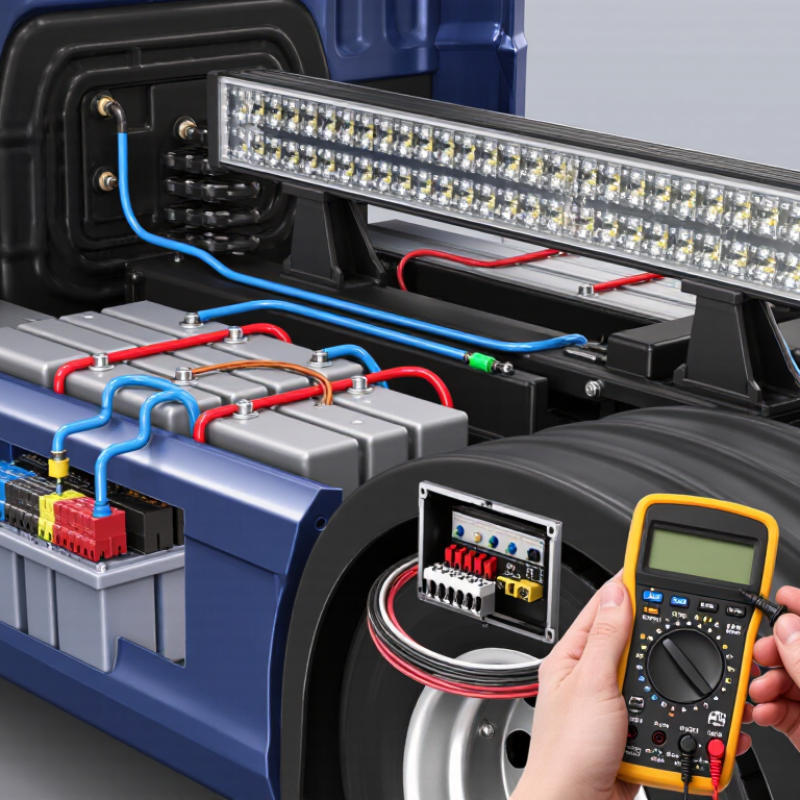
Why Is My LED Light Bar Not Working on My Truck?

Common Causes of a Truck LED Light Bar Failure

Why Is My LED Light Bar Not Working on My Truck?

A failed truck LED light bar usually has a simple cause: power is not reaching the LEDs. Check the fuse, relay, switch, and ground connection with a multimeter. A dark display on the switch may indicate a broken circuit. Loose terminals often hide behind the bumper, where road spray creates green corrosion. The U.S. Department of Energy’s Solid-State Lighting reports recognize LEDs for long service life, but only under suitable thermal and electrical conditions. Long life does not mean failure-proof.

Inspect the wiring for crushed insulation or sharp bends near the grille. Voltage should be measured at the light bar while the switch is active, not only at the battery. A large voltage drop suggests undersized wiring, a weak ground, or a failing relay. I have seen bars flicker after several minutes because heat exposed a poor crimp. That mistake is easy to miss. The SAE J575 lighting test standard emphasizes vibration, moisture, and thermal durability, which reflects real truck conditions.

Water intrusion is another common cause. Look for fogging behind the lens, darkened emitters, or rust around mounting screws. IEC 60529 ingress protection ratings describe resistance to dust and water, but installation still matters. A damaged seal can defeat a high-rated enclosure. The U.S. Department of Energy also notes that LED performance depends on heat management. If the bar works when cold and stops when hot, inspect airflow, mounting pressure, and the internal driver. Guessing wastes time. Test each section carefully.

Check the Power Source, Fuse, and Switch

Why Is My LED Light Bar Not Working on My Truck?

When an LED light bar stays dark, start at the power source. Open the hood and inspect the battery terminals, inline connections, and ground cable. A loose ring terminal can look secure while failing under vibration. I once found corrosion hidden beneath heat-shrink tubing. The connection felt tight, but the light flickered on rough roads. Use a multimeter to check battery voltage and confirm power reaches the light bar’s positive wire.

Check the fuse before replacing the light itself. A blown fuse usually indicates excessive current, a short, or incorrect wiring. Turn off the ignition, remove the fuse, and inspect the metal strip inside. Do not install a larger fuse. It can overheat the wiring and create a fire risk. If the replacement fails immediately, stop testing and inspect damaged insulation, crushed wires, or water inside the connectors.

The switch and relay deserve attention too. Test whether voltage enters and leaves the switch when it is turned on. A silent relay does not always mean it is defective, so measure its control and output terminals. Check the ground as well. It is easy to blame the switch too soon. I have made that mistake. Recheck every crimp, connector, and fuse holder, especially after washing the truck or driving through mud. If readings remain confusing, a qualified automotive technician can trace the circuit safely.

Inspect Wiring, Connectors, and Ground Connections

Why Is My LED Light Bar Not Working on My Truck?

A dead light bar often has a simple cause: poor wiring, loose connectors, or a weak ground. Turn off the vehicle before testing anything. Inspect the positive cable from the fuse or relay to the light bar. Look for crushed insulation, green corrosion, melted sections, or sharp bends near the grille. A fuse can appear intact but fail under load, so test voltage on both fuse terminals.

Check every connector closely. Moisture can hide inside a sealed plug, especially after muddy roads or pressure washing. The terminals should fit tightly and show no white or green residue. SAE J1128 covers low-voltage automotive cable requirements, including insulation and conductor performance. Incorrect cable size can create voltage drop and heat. That small detail matters.

The ground connection deserves equal attention. Attach it to clean, bare chassis metal, not painted or rusty steel. A loose ground may let the bar glow weakly, flicker, or stop after vibration. NFPA reports roughly 32,000 U.S. home fires annually involved electrical distribution or lighting equipment during 2016–2020. Trucks differ, but the warning remains useful: electrical connections should not be guessed at. I have seen technicians replace a light bar when the real fault was a corroded ground ring. That mistake is easy to make. Use a multimeter, check voltage at the light-bar terminals, and gently move each wire during testing. If voltage disappears, the wiring path needs closer inspection.

Why Is My LED Light Bar Not Working on My Truck? — Inspect Wiring, Connectors, and Ground Connections
Symptom What to Inspect How to Check Possible Fix
Light bar does not turn on Fuse, power wire, and battery connection With the circuit switched on, check for voltage at the light bar’s positive terminal. Inspect the fuse for a broken element and check both fuse terminals for power. Replace a blown fuse only with the specified type and rating. Repair loose or damaged wiring; do not install a higher-rated fuse to stop it from blowing.
Light bar flickers or cuts out over bumps Connectors, splices, and cable routing Look for loose locking tabs, corrosion, water intrusion, strained wires, or insulation rubbed through near sharp edges. Gently move the harness while the light is on. Clean and secure compatible connectors, replace damaged sections, and fasten the harness away from heat, moving parts, and sharp edges.
Light is dim or changes brightness Ground connection and voltage drop Inspect the ground connection for paint, rust, dirt, or looseness. Using a multimeter, measure voltage at the light while it is operating and compare it with battery voltage under the same conditions. Make the ground connection to a suitable clean metal point or the recommended ground location. Tighten it securely and protect the finished connection from corrosion.
Fuse blows repeatedly Short circuit, pinched wire, or incorrect circuit protection With power disconnected, inspect the wiring for crushed insulation, exposed copper, and contact with metal. Check that the fuse and wiring match the light’s installation specifications. Repair the short or damaged wiring and use the specified fuse rating. If the fuse continues to blow, have the circuit tested before reconnecting the light.
Switch illuminates, but the light bar stays off Relay, relay connections, and output wiring Check whether the relay clicks when the switch is operated. Verify power at the relay input and output using a multimeter, following the circuit diagram. Secure loose relay connections or replace a faulty relay with a matching type. Confirm that the relay is wired according to the installation instructions.
Light works intermittently after rain or washing Connector seals and cable entry points Check connectors for moisture, green or white corrosion, and damaged seals. Inspect any grommets where wires pass through body panels. Dry and replace compromised connectors or seals. Use weather-resistant components suitable for the location, and route cables to reduce water entry.
Light bar works when tested directly but not through the truck wiring Switch circuit, relay control wiring, and ground path Test for the correct control voltage at the relay coil and check continuity through the switch and ground path with power disconnected. Repair the open or high-resistance connection. Follow the vehicle and light-bar wiring instructions, especially when connecting to an electronic vehicle system.

Test the Relay and LED Light Bar

When an LED light bar goes dark, test the relay before replacing parts. Park the truck, switch off the ignition, and check the light bar’s fuse and wiring for corrosion, loose terminals, or damaged insulation. A relay may click when energized, but that sound alone does not prove its contacts are working. Not proof. With a multimeter, check for battery voltage at the relay’s power terminal and confirm that its control terminal receives power when the switch is on. Follow the vehicle’s wiring diagram; terminal layouts can differ. Keep the probes from bridging adjacent contacts.

If the relay has power and a good ground, check whether voltage reaches the light bar when the switch is on. No output at the relay points toward a relay, control-wire, or ground issue. Voltage at the bar but no light suggests a poor connection, reversed polarity, or a failed bar. To test the bar separately, use a short, fused lead matched to its rated voltage, and connect it with the correct polarity. Avoid loose wires near the battery. A direct test can isolate the fault, though it may not reveal an intermittent connection that appears only when the truck vibrates. Recheck the ground under load; a clean-looking bolt can still make weak contact.

Repair the Fault and Verify Operation

A truck LED light bar that stays dark may have a simple wiring fault, not a failed lamp. Start with the basics. Park safely, switch off the lights, and disconnect the battery’s negative terminal before handling wires. Inspect the fuse, relay, switch, and connectors for loose pins, melted insulation, or green corrosion. Replace a blown fuse only with one of the specified rating; a larger fuse can let damaged wiring overheat.

Use a multimeter to check for voltage at the light bar while the switch is on. No voltage points toward the power supply, relay, switch, or wiring. If voltage is present, check the ground connection and look for a poor crimp or a loose mounting bolt. A clean-looking connector can still fail under load. Dry and secure connections, and replace damaged sections with wire suited to the circuit. It is easy to blame the light bar too soon.

Reconnect the battery and test the repair with the engine off, then briefly with it running. Confirm the bar turns on consistently, the switch behaves normally, and no wires or connectors become warm. Gently move the harness while the lights are on; flickering can reveal an intermittent connection. If the fuse blows again, stop testing and trace the short rather than fitting another fuse. A small fault can be stubborn.

FAQS

What should I check when an LED light bar suddenly goes dark?

Park safely and switch off the ignition. Inspect the fuse, relay, switch, wiring, and connectors. Look for green corrosion, loose terminals, melted insulation, or damaged wires. Start with simple faults.

Does a clicking relay prove that it works correctly?

No. A click only shows that the relay may be energizing. Its internal contacts could still fail. Test the relay with a multimeter.

How can I test power at the relay?

Follow the vehicle’s wiring diagram carefully. Check battery voltage at the relay’s power terminal. Confirm control-terminal voltage when the switch is on. Keep the probes from touching adjacent contacts.

What does no voltage at the light bar indicate?

It suggests a problem with the fuse, relay, switch, control wire, ground, or power cable. Test each section separately. A wiring fault is often blamed on the lamp too soon.

What does voltage at the light bar but no light mean?

Check the ground connection, polarity, connector, and mounting bolt. A clean-looking connection can fail under load. Recheck it while the light is switched on.

How can I test the light bar separately?

Use a short, fused lead with the correct rated voltage. Connect it with the correct polarity. Keep loose wires away from the battery. This can isolate the fault, but it may miss vibration-related failures.

How should I replace a blown fuse?

Use only the specified fuse rating. A larger fuse can overheat damaged wiring. If the replacement blows again, stop testing and trace the short.

How can I confirm that a repair is reliable?

Reconnect the negative battery terminal and test with the engine off. Then test briefly with the engine running. Gently move the harness while the lights operate. Flickering may reveal an intermittent connection. I might still overlook a weak ground.

Conclusion

When a truck LED light bar stops working, the cause may be a weak power source, a blown fuse, a faulty switch, damaged wiring, loose connectors, or a poor ground connection. Start by checking that the battery supplies adequate power and that the fuse and switch are functioning. Then inspect the wiring for wear or loose connections, and make sure the ground is clean and secure. These basic checks can help narrow down the fault before replacing any parts.

If the power supply and connections appear sound, test the relay and the light bar to identify which component is failing. You may wonder, “Why can't I get my LED light bar to work properly on my truck?” A systematic check of each part of the circuit can provide the answer. Repair or replace the faulty component, secure any connections, and test the light bar again to verify that it operates reliably.

Amelia

Amelia

Amelia is a seasoned marketing professional with a wealth of expertise in our company’s core offerings. With an unwavering passion for driving growth and innovation, she plays a pivotal role in shaping our marketing strategies and enhancing brand visibility. A key aspect of her responsibilities......