 Experts LED Lighting
How to Choose Energy Efficient LED Driving Lights?
Choosing energy-efficient LED driving lights begins with more than comparing wattage or advertised brightness. What makes LED driving lights more energy-efficient than traditional ones? Their semiconductor design converts a greater share of electrical power into usable light, while halogen lamps release much energy as heat. The U.S. Department of Energy reports that LED lighting can use at least 75% less energy than incandescent technology and last up to 25 times longer. Although these figures concern general lighting, they provide a useful technical benchmark for vehicle lighting decisions.
For driving applications, examine lumens per watt, beam distance, colour stability, and real measured lux. A lower-wattage lamp is not automatically better. Poor optics can waste light outside the road, forcing drivers to install brighter units. That creates unnecessary alternator demand. Good LED driving lights place a controlled beam on distant road markings, reflective signs, and roadside hazards. Their aluminium housing should also move heat away from the LEDs. Excessive heat reduces output and can shorten service life.
The International Energy Agency identifies lighting efficiency as an important part of global electricity-saving efforts. However, vehicle conditions are different. Vibration, dust, rain, voltage variation, and mounting angle matter. Independent testing therefore remains essential. Look for documented photometric results, thermal testing, and credible compliance information rather than impressive packaging claims. I have found that real-world beam performance can disappoint, even when laboratory numbers look excellent. This is where careful comparison matters. No single specification tells the whole story.
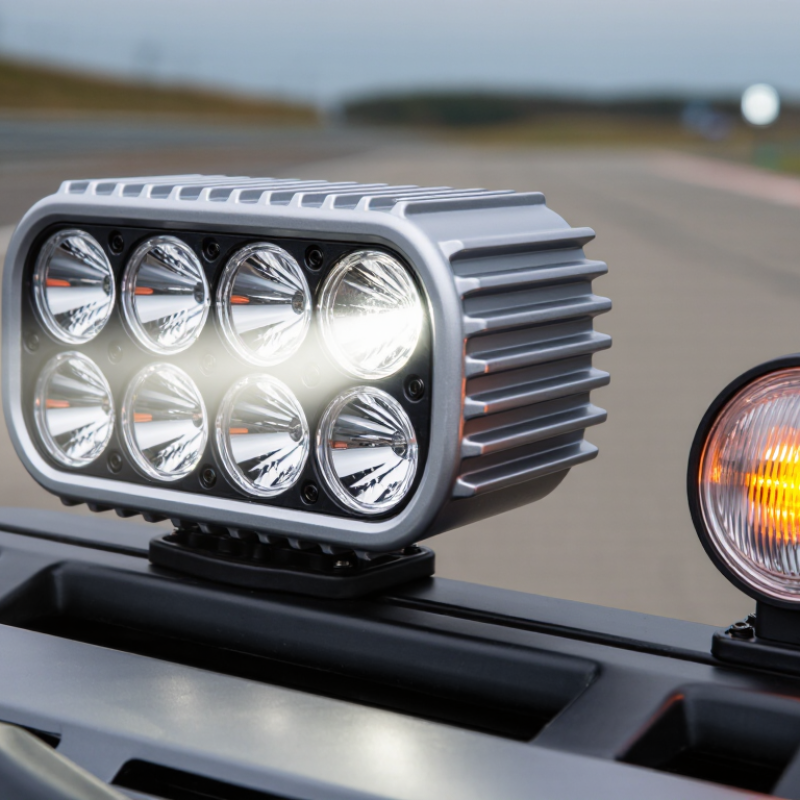
Define LED Driving Light Energy Efficiency
Energy efficiency in an LED driving light means producing useful road illumination with less electrical power. The most practical measure is luminous efficacy, expressed in lumens per watt, but this figure needs context. A lamp may advertise impressive lumens while wasting energy through heat, glare, or an inefficient driver. Look beyond brightness. Check the actual power draw at the vehicle’s operating voltage, not only the stated peak output.
An efficient light uses a well-matched LED, a stable current driver, and a housing that removes heat. Heat matters because excessive temperature reduces output and can shorten component life. In workshop testing, compare lux at a fixed distance, beam coverage, and power consumption after the lamp reaches operating temperature. This reveals performance that a cold-start test can hide. A wide beam is not automatically efficient. It may place light outside the useful driving area.
Reliable specifications should identify measured lumens, input watts, voltage range, operating temperature, and testing conditions. Independent testing or recognized electrical safety and ingress ratings can support confidence, though certification alone does not prove superior road performance. I would also inspect connectors, heat sinks, and mounting stability after repeated night drives. Small details count. The difficult part is judging “useful light,” because road shape, weather, and installation change the result. A lower-power lamp can sometimes illuminate more effectively than a brighter, poorly aimed one. That is worth questioning.
FAQS
No. Lumens measure total light output, not beam control. A focused 6,000-lumen lamp may outperform a poorly aimed 10,000-lumen lamp.
Divide lumens by watts. For example, 6,000 lumens divided by 60 watts equals 100 lumens per watt. This estimate excludes wiring and cooling losses.
A narrow beam helps on open highways. A wider beam reveals nearby edges on winding roads. A combination pattern balances distance and coverage.
Wet roads reveal glare, dark gaps, and weak beam control. A beam that looks excellent on dry asphalt may perform poorly after rain.
Confirm whether the vehicle uses 12 or 24 volts. A 60-watt lamp draws about 5 amps at 12 volts. Two lamps need roughly 10 amps.
Use a fused relay circuit, suitable cable, and a clean chassis ground. Check alternator capacity. Measure voltage at the lamp, not only at the battery.
Review lux, beam distance, current draw, input voltage range, thermal design, and water resistance. Measured photometric data is more useful than packaging claims.
Avoid excessive brightness and very cool white light. Moisture can reflect light toward your eyes. A controlled beam often feels safer.
Choose sealed housing, strong brackets, protected cables, and effective heat dissipation. Inspect connectors after wet trips. Check mounting hardware after several drives.
I once focused too much on brightness and ignored beam alignment. The result was harsh glare and poor coverage. Aim carefully and check local road rules.
Conclusion
Choosing energy-efficient LED driving lights starts with understanding how effectively they convert electrical power into useful illumination. What makes LED driving lights more energy-efficient than traditional ones? They typically produce more usable lumens per watt, waste less energy as heat, and maintain strong beam performance with lower power consumption. However, brightness alone is not enough; compare lumen output, wattage, beam distance, width, and consistency to find a balanced design.
Next, confirm that the light’s voltage and current requirements match your vehicle’s electrical system and power source. Reliable construction, efficient heat dissipation, sealed housing, vibration resistance, and corrosion protection can help preserve performance and extend service life. Finally, select a beam pattern and brightness suited to your driving conditions, such as open roads, poor weather, or uneven terrain. The best choice delivers clear visibility while minimizing electrical demand, overheating, maintenance, and unnecessary energy use.
