Choosing the right LED driving lights is crucial for safe night driving. As visibility decreases after sunset, poor lighting can lead to serious accidents. The National Highway Traffic Safety Administration (NHTSA) reports that nearly 50% of all traffic deaths occur at night, despite nighttime trips accounting for only 25% of total travel. This stark reality emphasizes the need for reliable lighting solutions.
"Why are LED driving lights essential for night driving?" asks automotive lighting expert Dr. Emily Carter. She emphasizes, "Proper illumination is not just about seeing; it's about being seen." This statement highlights the dual role of effective lighting—enhancing driver visibility while ensuring that others on the road can see your vehicle as well.
LED lights boast longevity and efficiency. They provide a brighter, clearer light compared to traditional options. However, choosing the right LED lights can be overwhelming with numerous options available. Inconsistent performance can lead to frustration. It's important to consider factors like beam pattern, brightness, and durability to ensure optimal safety. As technology advances, the choice of LED lights can either enhance or detract from your night driving experience. Make informed decisions to protect yourself and others on the road.
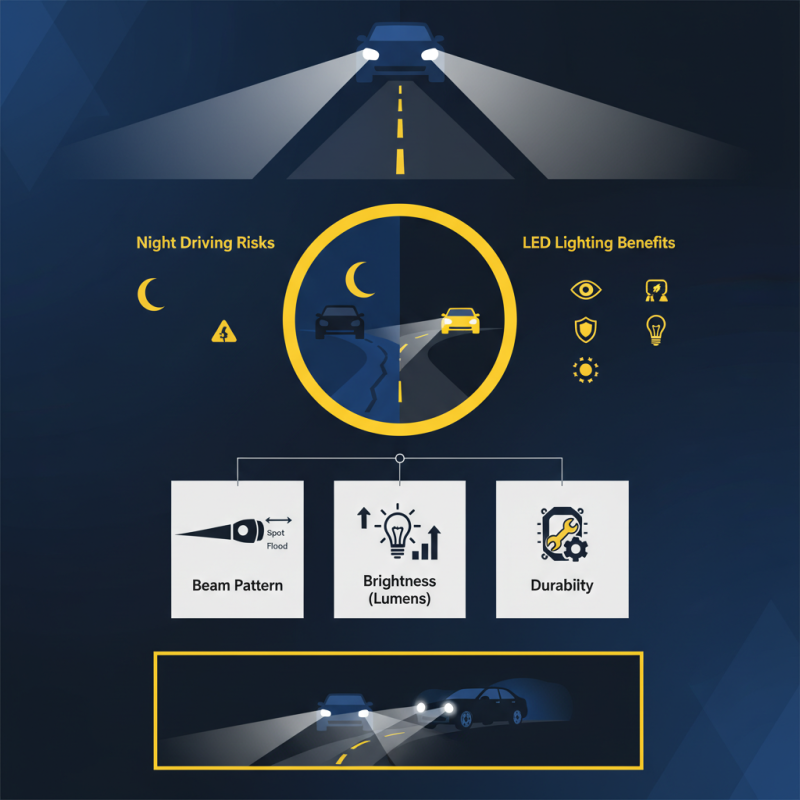
Choosing the Right LED Driving Lights for Enhanced Visibility at Night
When it comes to driving at night, visibility is vital for safety.
Choosing the right LED driving lights can genuinely enhance your experience on the road.
Start by considering the brightness.
A higher lumen output is beneficial but can sometimes be overpowering. Finding a balance is key.
Aim for a light that illuminates the road without blinding oncoming traffic.
Next, think about the beam pattern.
Some lights provide a wide spread, while others focus on long-distance visibility. It depends on your driving habits.
A combination may be necessary for various terrains.
Off-road enthusiasts might prioritize longer beams, while city drivers may want a broader spread.
Quality matters too; durable materials will ensure longevity.
Consider water and dust resistance. This adds reliability under various conditions.
Finally, reflect on your mounting options.
Proper installation is crucial. Misaligned lights can lead to glare and reduced effectiveness.
Experiment with positioning to find the optimal angle. This might require adjustments over time.
Each vehicle is different, and what suits one may not suit another.
Remember, the right choice enhances visibility and promotes safer road experiences.
Understanding Lumens and Lux for Optimal Nighttime Brightness
When selecting LED driving lights for night driving, it's essential to understand lumens and lux. Lumens measure the total light output of a bulb. A higher lumen rating means brighter lights. However, brightness alone doesn't guarantee safe driving. Lux, on the other hand, measures brightness per square meter at a specific distance. This indicates how well a light illuminates an area.
Choosing the right balance between lumens and lux can be tricky. Some lights may have high lumen counts but poor lux distribution. This can create glare for oncoming drivers, leading to unsafe conditions. It's important to look for lights that provide an even distribution of light. Ideally, you want lights that illuminate the road ahead without blinding others.
Many drivers overlook the importance of light color temperature. Warmer colors, around 3000K, offer better visibility in foggy conditions. Cooler temperatures, around 6000K, can provide a sharper contrast in clear weather. Experimenting with different light temperatures can help identify what works best for your driving conditions. Striking the right balance enhances visibility while ensuring safety.
LED Driving Lights Brightness Comparison
Evaluating Beam Patterns: Spot vs. Flood for Diverse Driving Conditions
When choosing LED driving lights, understanding beam patterns is crucial.
Spot and flood patterns serve different purposes.
Spot beams provide focused light, ideal for long-distance visibility. They illuminate distant objects, making them great for highways.
Flood beams spread light over a wider area, offering enhanced visibility for off-road driving or in foggy conditions.
Each pattern can change your driving experience significantly.
Consider what you frequently encounter. If you're mostly on highways, spot beams become essential.
They help detect animals or obstacles far ahead. However, if you navigate tight trails or worksite areas, flood patterns outperform.
They light up immediately around you, minimizing blind spots. A mix of both can give you versatility.
Tip: Always evaluate your driving environment. A solution that works for one driver may not suit another.
Take your time comparing products. Quality varies widely in the market. Make informed choices based on reliability rather than flashy designs.
Another tip: don't overlook the mounting position. Incorrect installation can limit effectiveness or create dangerous glare for others.
Stay aware of potential hazards. Your safety depends on the choices you make.
Assessing Durability: IP Ratings and Material Quality in LED Lights
When selecting LED driving lights for night driving, durability is crucial. IP ratings indicate how well a light can resist dust and water intrusion. An IP rating of at least IP67 is advisable for off-road conditions. This rating means the lights can withstand submersion in water up to one meter for 30 minutes. In comparison, an IP65 rating only provides protection against water projected from a nozzle.
Material quality also plays a significant role. Aluminum housing is often heavier but more durable than plastic. A study by the Lighting Research Center found that well-constructed aluminum lights have a lifespan exceeding 50,000 hours. However, cheaper lights might only last a fraction of this. Choosing lights with high-quality seals can prevent moisture entry, which can damage internal components over time. While most lights look impressive on the outside, it's the interior construction that often separates reliable products from poor ones.
Price should not be the sole decision factor. Many low-cost options might perform well initially but fail in harsh environments. Always consider how the materials and ratings will hold up in your specific conditions. Proper research and understanding will aid in making an informed choice, ensuring safety during night-time adventures.
Power Consumption and Efficiency: Balancing Performance with Energy Use
When selecting LED driving lights,
power consumption and
efficiency are crucial. High-performance lights often consume more energy.
Yet, energy-efficient options can provide ample illumination without draining
your vehicle's battery. Understanding your vehicle's power capacity
helps in making informed choices.
Consider the brightness of the lights. Higher lumens mean better visibility.
However, this can lead to increased power use. It’s tempting to go for the brightest option,
but excessive brightness can blind other drivers. Moderation is key. Look for a
balance between wattage and light output.
The design also impacts efficiency. Opt for lights with a good heat dissipation system.
Overheating can reduce a light's lifespan and worsen efficiency. Reflect on your driving habits, too.
For occasional night use, you might not need high-powered options.
Prioritize both
safety and energy use. Seek lights that offer durability without excessive drain on your resources.
FAQS
: Spot beams focus light for long distances, ideal for highways. Flood beams spread light over a wider area for better visibility.
If you frequently drive on highways, spot beams help detect distant animals or obstacles.
Flood patterns illuminate areas around you, making them great for off-road driving or tight trails.
Using both styles provides versatility for different driving conditions, enhancing overall safety.
High-performance lights may use more energy. Balancing efficiency with performance is crucial for battery life.
Higher lumens provide better visibility but can lead to increased power use. Moderation is essential.
Choose lights with good heat dissipation. Overheating can shorten lifespan and decrease efficiency.
If you drive at night occasionally, you might not need high-powered lights. Adjust your choices accordingly.
Incorrect mounting can limit light effectiveness and cause glare. Always consider surroundings for safety.
Compare products carefully. Quality varies significantly, so prioritize reliability over flashy designs.
Conclusion
When selecting LED driving lights for safe night driving, it's crucial to consider several factors that enhance visibility and driving comfort. First, understanding lumens and lux helps determine the optimal brightness necessary for nighttime conditions, ensuring that the light output is adequate for safe navigation. Evaluating beam patterns, such as spot versus flood, is essential as different patterns cater to various driving scenarios, providing either focused illumination or broad coverage.
Durability is another key aspect, with IP ratings and material quality indicating how well the lights can withstand challenging environments. Additionally, assessing power consumption and efficiency is vital for balancing performance with energy use. Ultimately, LED driving lights are essential for night driving because they significantly improve visibility and safety, enabling drivers to detect obstacles and navigate roadways with confidence.
 Experts LED Lighting
