 Experts LED Lighting
China Top 10 Marine LED Lights How to Use Them?
Choosing the right marine light is not only a style decision. It affects battery endurance, night vision, heat, wiring, and onboard safety. The U.S. Department of Energy reports that LED products use at least 75% less energy than incandescent lighting and can last up to 25 times longer. That advantage matters on boats, where every amp-hour counts. Still, a bright light can be the wrong light.
This guide, “China Top 10 Marine LED Lights How to Use Them?”, examines practical choices for navigation areas, cabins, engine rooms, decks, and underwater applications. Nigel Calder, a respected marine systems author, offers a useful principle: “Use the light for the task, not merely for appearance.” The wording is simple. The installation is not. Beam angle, color temperature, IP or IEC protection, corrosion resistance, dimming compatibility, and voltage stability all require attention. A 12-volt lamp may work perfectly in one boat and fail early in another.
Industry guidance from the American Boat and Yacht Council, together with ISO marine electrical standards, stresses correct circuit protection, secure connections, and suitable equipment for wet environments. These recommendations support a professional approach, but product labels alone do not prove marine reliability. Independent testing, supplier documentation, and real installation experience remain important.
So, How to use LED lights for boat and marine applications? Begin with the job, measure the circuit, and inspect the environment. Use warm light where glare matters. Use focused beams where visibility matters. Leave room for doubt. Even a well-designed lighting plan may need adjustment after one night on the water.
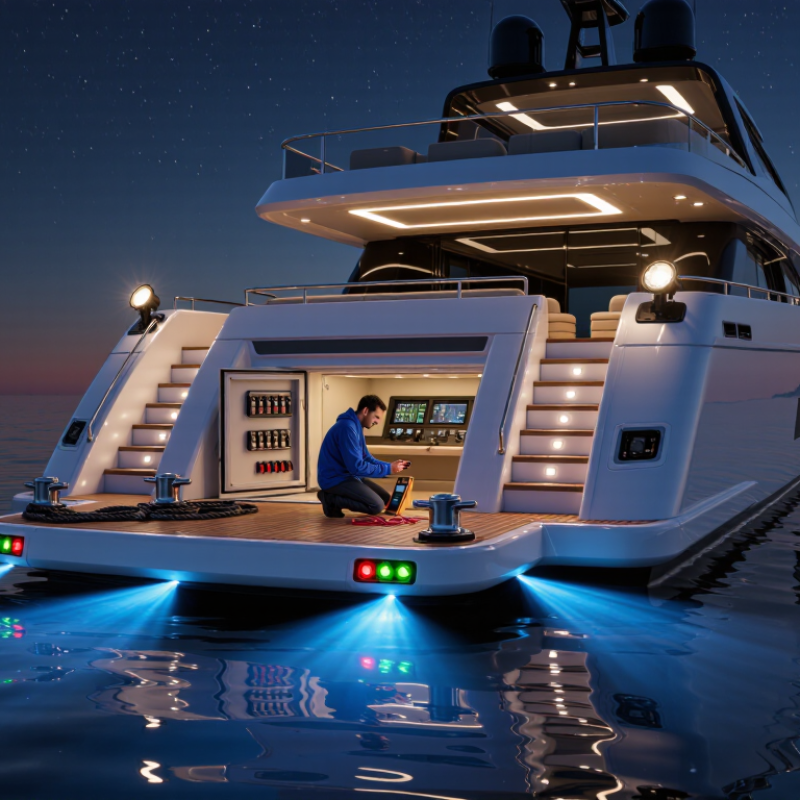
What Are Marine LED Lights and Why Are They Used?
Marine LED lights are solid-state lamps designed for boats, docks, and offshore equipment. They use light-emitting diodes instead of fragile filaments. Their compact housings fit under gunwales, inside cabins, and around engine rooms. Sealed models also resist spray, vibration, and salt exposure. Not every LED is truly marine-ready.
The U.S. Department of Energy reports that LED lighting uses at least 75% less energy and can last up to 25 times longer than incandescent lighting. This matters on boats, where batteries and charging time are limited. The International Energy Agency also identifies efficient lighting as a practical way to reduce electricity demand. In daily use, a warm-white LED can illuminate a chart table without creating harsh glare. A cool-white beam may help on deck, but it can reduce night vision.
Use navigation lights only when the product meets applicable maritime approval requirements. Cabin, courtesy, spreader, and underwater lights serve different purposes. Check the ingress-protection rating, voltage range, cable quality, and heat control before installation. My early assumption was simple: brighter must be better. It was wrong. Excessive brightness can reflect from wet decks and disturb nearby operators. I also learned that poor sealing causes failures faster than ordinary aging. Regularly inspect gaskets, connectors, and corrosion around mounting screws. A small installation mistake can waste the energy savings.
China Top 10 Marine LED Lights How to Use Them? - What Are Marine LED Lights and Why Are They Used?
Marine LED lights are energy-efficient lighting products designed for boats, docks, marinas, and other saltwater environments. The table below summarizes ten commonly used marine LED light types, their typical specifications, applications, and practical usage guidance.
| No. | Marine LED Light Type | Typical Power | Common Color / CCT | Typical Protection | Main Applications | How to Use Them | Why They Are Used |
|---|---|---|---|---|---|---|---|
| 1 | Navigation Lights | 1–10 W | Red, green, or white | Usually IP65–IP67 | Bow, stern, and mast lighting | Install in the prescribed positions and connect to the vessel's navigation-light circuit. | They provide clear vessel visibility while consuming little battery power. |
| 2 | Underwater Lights | 10–100 W | Blue, white, green, or RGB | IP68 for submerged use | Hull illumination, fishing, and underwater visibility | Mount below the waterline according to the installation manual and use marine-grade cable connections. | They illuminate the water around the hull and can improve nighttime visibility. |
| 3 | Deck and Cockpit Lights | 3–20 W | Warm white, 2700–3500 K | IP65–IP67 | Decks, cockpits, walkways, and seating areas | Use recessed or surface-mounted fixtures aimed away from the operator's eyes. | They provide comfortable task lighting with lower heat output than many traditional lamps. |
| 4 | Cabin and Interior Lights | 2–15 W | Warm white or neutral white, 2700–4500 K | IP44–IP65, depending on location | Cabins, galley areas, corridors, and sleeping quarters | Select low-glare fixtures and use dimming where nighttime comfort is important. | They reduce energy consumption and extend operating time between battery charges. |
| 5 | Floodlights and Searchlights | 20–150 W | Cool white, 5000–6500 K | IP66–IP67 | Work decks, docking, anchoring, and emergency searching | Aim the beam only at the required area and avoid shining directly into another operator's vision. | They deliver strong, directional illumination for safety and nighttime operations. |
| 6 | Courtesy and Step Lights | 0.5–5 W | Warm white, red, or blue | IP65–IP67 | Steps, handrails, doorways, and low-level walkways | Install at low height with shielded lenses to create an even path of light. | They help prevent trips and falls without creating excessive glare on deck. |
| 7 | Fishing and Bait Lights | 10–80 W | Green, blue, or white | IP67–IP68 | Fishing boats, bait wells, and night fishing areas | Position the light to illuminate the working area or water without obstructing navigation equipment. | They provide efficient task lighting and may attract or concentrate organisms depending on conditions. |
| 8 | Engine-Room and Utility Lights | 5–30 W | Neutral white, 4000–5000 K | IP65–IP67 | Engine rooms, lockers, storage compartments, and machinery spaces | Use vibration-resistant fixtures and keep wiring clear of heat, fuel, and moving components. | They offer reliable illumination in confined spaces while producing less heat and using less current. |
| 9 | Anchor and All-Round Lights | 1–10 W | White | IP65–IP67 | Anchored or moored vessels | Mount where the light can be seen from the required angles and operate it according to local regulations. | They improve the visibility of stationary vessels while requiring minimal electrical power. |
| 10 | Dock and Marina Lights | 10–100 W | White, 3000–5000 K | IP66–IP68 | Piers, pontoons, boat slips, and shoreline facilities | Install above splash level where possible, use corrosion-resistant hardware, and provide suitable circuit protection. | They improve access and security in wet outdoor areas with long service life and low maintenance. |
FAQS
Marine LED lights illuminate cabins, decks, steps, engine areas, and underwater spaces. Different locations need different light types. Brightness alone is not enough.
LEDs use much less energy than incandescent lamps. They can also last far longer. This helps when batteries and charging time are limited.
No. Choose models designed for spray, vibration, salt, and temperature changes. Check sealing, voltage range, cable quality, and heat control.
Disconnect batteries and shore power before cutting cables. Check polarity with a multimeter. Install a correctly rated fuse near the power source.
Use tinned copper cable, sealed connectors, and adhesive-lined heat-shrink tubing. Keep connections above likely bilge water. Add a small drip loop.
Select a rating suitable for spray or immersion. IP67 can support temporary water exposure. Always match the light to its installation depth.
No. Navigation lights require approved colors, visibility, and positioning. Cabin or courtesy lights cannot replace them.
Poor seals, voltage drops, shared fuses, and loose connections can cause failures. Wet decks may reflect excessive brightness. I once assumed brighter was better. It was not.
Test each light at dusk, not only indoors. Inspect gaskets, connectors, screws, corrosion, and cable damage regularly. Salt leaves a film. Recheck seals after the first trip.
Conclusion
This guide explains how marine LED lights improve visibility, safety, comfort, and energy efficiency on boats and other marine vessels. It introduces ten practical types, including navigation, anchor, deck, cabin, courtesy, underwater, flood, spotlight, engine-room, and spreader lights. Readers will learn how to select suitable lights according to brightness, color, beam angle, waterproof rating, power compatibility, mounting position, and intended use. The guide also answers the question, “How to use LED lights for boat and marine applications?” by showing how different lights support navigation, working areas, nighttime movement, and onboard comfort.
It also provides clear guidance for safe installation, including checking the power system, using properly protected connections, sealing openings, and positioning lights to avoid glare or obstructed visibility. Regular cleaning, inspection, corrosion prevention, and testing can extend service life. Basic troubleshooting advice helps identify common problems such as flickering, dim output, water intrusion, loose wiring, or power failure, allowing users to maintain reliable lighting performance in various marine environments.
